BMI Calculator for Women (Accurate and Free Online Tool)
BMI Calculator for Women
Enter your height and weight to calculate your BMI score instantly.
Disclaimer: BMI is a screening tool and does not diagnose health conditions.
BMI Calculator for Women helps you check if your weight matches your height. It gives you a quick number called BMI (Body Mass Index). That number places you into a category like underweight, normal, overweight, or obese. Many women use BMI as a starting point because it feels simple and objective. No drama. No judgment. Just a clear result.
BMI Calculator for Women works with kg and cm or pounds and inches. You can also add your age for extra context. Doctors and health organizations use BMI because it helps identify health risks across large groups. Both the World Health Organization (WHO) and the Centers for Disease Control and Prevention (CDC) use BMI categories for adults. Still, BMI is not perfect. It cannot measure muscle, body fat percentage, or where fat is stored. But it remains a useful tool for tracking trends over time.
Calculate Your BMI (Women)
You can calculate your BMI in under a minute. Just enter your height and weight. The BMI Calculator for Women will show your BMI score and weight category instantly.
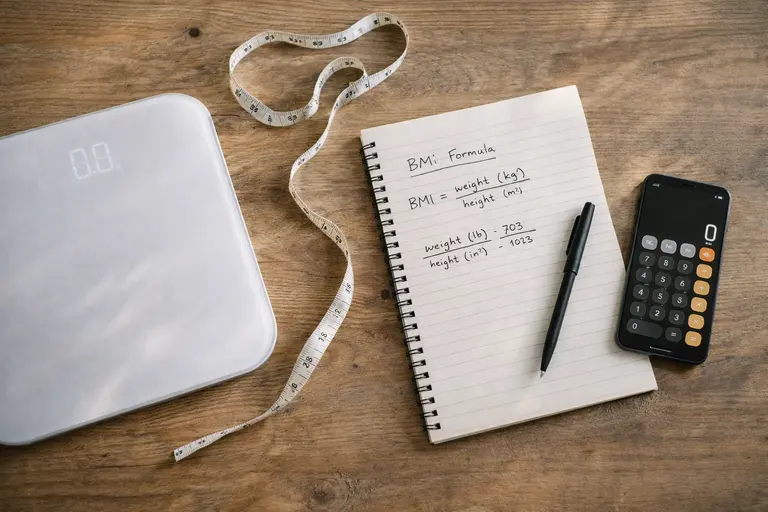
Enter Your Height
Use centimeters or feet and inches. Measure without shoes. Stand straight against a wall. A one-inch error can change your BMI result.
Enter Your Weight
Use kilograms or pounds. Try to weigh yourself in the morning for consistency. Your weight can shift daily. Water retention often increases before your period. That can raise the scale without adding fat. Don’t stress about daily changes. Look at patterns over several weeks.
Add Your Age (Optional but Helpful)
BMI Calculator for Women: Age does not change the BMI formula. But it changes how your body behaves. After 30, many women lose muscle slowly. After 40, hormones often shift. After 50, menopause may change fat storage. I noticed this myself. My weight stayed stable in my late 30s, but my waist grew. That taught me a lesson. BMI matters, but body shape matters too.
Pregnancy Note (Important)
If you are pregnant, BMI still uses the same formula. But doctors usually calculate BMI using pre-pregnancy weight. During pregnancy, weight gain guidelines matter more than BMI. Your doctor or midwife should guide you.
Your BMI Result (Rounded)
Most calculators round BMI to one decimal. That makes it easier to track and compare.
Your BMI Category
Your BMI will fall into one category:
Your category does not define your value. It only gives health context.
Healthy BMI Range for Women
For most adult women, the healthy BMI range stays between 18.5 and 24.9.
Healthy Weight Range Based on Height
Many women find this more useful than BMI alone. It answers a real question:
“What weight range makes sense for my height?”
What Is a Healthy BMI for Women?
BMI Calculator for Women: A healthy BMI for most adult women falls between 18.5 and 24.9. Doctors link this range with a lower risk of heart disease, diabetes, and high blood pressure.
But BMI does not tell the full story. It does not measure:
Think of BMI as a starting point. It works like a dashboard light. It tells you when to look closer. Some women feel anxious when they check BMI. That reaction makes sense. Weight feels personal. But BMI should feel like information, not criticism. Doctors often check other markers too, including waist size, blood sugar, cholesterol, and blood pressure.
Healthy BMI Range Table (Adult Women)
|
BMI Range |
Weight Status |
|---|---|
|
Below 18.5 |
Underweight |
|
18.5–24.9 |
Healthy weight |
|
25.0–29.9 |
Overweight |
|
30.0 and above |
Obese |
If your BMI falls outside the healthy range, don’t panic. Use it as a sign to learn more.
BMI Chart for Women (Standard Categories)
BMI Calculator for Women: A BMI chart helps you understand what your number means. It places you into a category and gives a general risk level. Health experts use BMI because it connects with long-term risk trends. WHO uses these same categories worldwide. BMI still has limits. It cannot tell if weight comes from muscle or fat. It also cannot show where fat sits. Belly fat carries higher risk than hip fat, especially after 40.
BMI Categories Table
|
BMI Value |
Category |
Risk Level |
|---|---|---|
|
Below 18.5 |
Underweight |
Moderate to High |
|
18.5–24.9 |
Normal weight |
Low |
|
25.0–29.9 |
Overweight |
Moderate |
|
30.0–34.9 |
Obesity Class I |
High |
|
35.0–39.9 |
Obesity Class II |
Very High |
|
40.0+ |
Obesity Class III |
Extremely High |
When I first saw “obesity class” labels, I hated them. They felt harsh. But doctors use these terms for risk tracking, not shame.
BMI should guide you, not hurt you.
How BMI Is Calculated for Women
BMI Calculator for Women: BMI compares weight to height. The formula stays the same for men and women. Height changes everything. A taller woman can weigh more and still stay healthy. A shorter woman can reach a high BMI quickly. BMI also does not separate muscle from fat. That is why athletic women sometimes show “overweight” results.
BMI Formula in Metric (kg/m²)
BMI = weight (kg) ÷ height² (m)
To convert centimeters into meters, divide by 100.
BMI Formula in Imperial (lbs/inches)
BMI = 703 × weight (lb) ÷ height² (in)
The number 703 adjusts the formula for U.S. measurements.
Example BMI Calculator for Women
Example 1: BMI in kg and cm
165 cm = 1.65 m
1.65 × 1.65 = 2.7225
60 ÷ 2.7225 = 22.0
BMI = 22.0 (Healthy range)
Example 2: BMI in pounds and inches
5’5” = 65 inches
65 × 65 = 4225
703 × 150 = 105450
105450 ÷ 4225 = 24.9
BMI = 24.9 (Healthy range)
Small measurement mistakes can change your result. Always measure carefully.
BMI Calculator for Women by Age (Does Age Matter?)
BMI Calculator for Women: Adult BMI categories stay the same at 25, 45, or 65. A BMI of 22 means the same thing on paper. But your body changes with age. That changes how BMI feels in real life. After 30, many women lose muscle slowly. After 40, hormones shift. After 50, menopause changes fat storage. BMI also cannot show belly fat. Belly fat increases health risks more than hip fat. Doctors call this visceral fat. That is why age matters, even when BMI ranges do not.
BMI for Women Over 40
After 40, estrogen often drops. Stress and sleep problems may increase. These changes can raise appetite and cravings. Muscle loss also becomes more common. Less muscle means slower metabolism. I’ve seen women panic when the scale barely changes, but their clothes fit tighter. That’s usually body composition, not “failure.” Waist size matters more than most women realize.
BMI for Women Over 50
After 50, menopause becomes a major factor. Fat storage shifts toward the abdomen. Bone health also becomes critical. A very low BMI may increase osteoporosis risk. A high BMI may increase joint strain. At this stage, strength matters as much as weight. A normal BMI does not always mean a healthy body. But it still gives a useful reference point.
BMI for Different Stages of a Woman’s Life
A woman’s body changes across life stages. Growth, pregnancy, and menopause all affect weight patterns. BMI can still help, but you must use the right method.
BMI Calculator for Teenage Girls
Teen girls should not use adult BMI charts. Doctors use BMI-for-age percentiles instead. Teen bodies grow fast. Weight gain may support healthy development. The CDC provides growth charts for this reason. If a teen struggles with rapid weight loss or missed periods, a doctor should evaluate it.
BMI Calculator for Adult Women
Adult women use standard BMI categories. These ranges apply to ages 18 and above. BMI works best when paired with waist measurement and lifestyle habits.
BMI Calculator for Pregnant Women
Doctors often BMI Calculator for Women using pre-pregnancy weight. Pregnancy weight gain guidelines matter more than BMI. Healthy pregnancy weight gain depends on your starting BMI. Your doctor should guide you safely.
BMI After Pregnancy (Postpartum)
Postpartum weight loss takes time. Your body needs recovery. Hormones stay unstable for months. Breastfeeding also affects appetite and calorie needs. Some women lose weight quickly. Others hold weight longer. Both can be normal. I think postpartum care should focus on healing first. When stress drops, weight often follows.
BMI vs Body Fat Percentage for Women
BMI measures weight compared to height. It does not measure fat directly. Women naturally carry more body fat than men. That supports hormones and reproductive health. So BMI can misclassify some women. A muscular woman may show “overweight” even with low body fat. Another woman may have a normal BMI but high body fat. Doctors sometimes call that normal weight obesity. Body fat percentage gives deeper insight, but it needs special tools.
BMI vs Body Fat Comparison
|
Tool |
Measures |
Best For |
Limitation |
|---|---|---|---|
|
BMI |
Weight vs height |
Fast screening |
Cannot separate fat and muscle |
|
Body Fat % |
Fat percentage |
Body composition |
Needs special testing |
|
Waist-to-Hip Ratio |
Fat distribution |
Belly fat risk |
Requires careful measurement |
|
Waist Circumference |
Waist size |
Metabolic risk |
Doesn’t factor height |
BMI gives a broad view. Waist size and body fat add clarity.
Waist-to-Hip Ratio for Women (Better Risk Indicator)
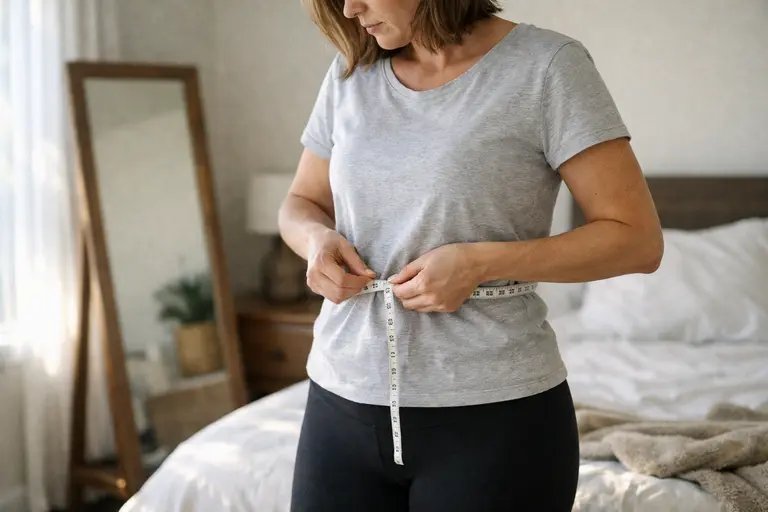
BMI Calculator for Women: BMI cannot show where fat is stored. Waist-to-hip ratio (WHR) helps fill that gap. WHR compares your waist size to your hip size. It helps show whether you store fat mostly around the belly or hips. Belly fat increases risk more than hip fat. Visceral fat surrounds organs and links with insulin resistance. You can have a normal BMI and still carry risky belly fat. That’s why WHR matters.
Ideal WHR Range for Women
Most health guidelines consider:
WHO recognizes WHR as a useful marker for abdominal obesity risk.
How to Measure Waist-to-Hip Ratio
Example:
Waist: 32 inches
Hips: 40 inches
WHR = 32 ÷ 40 = 0.80
This is one of the most useful health numbers many women never track.
Healthy Weight Range for Women by Height
Many women want a realistic weight range. This table uses the normal BMI range of 18.5 to 24.9. It offers flexibility. It does not force you into one exact number.
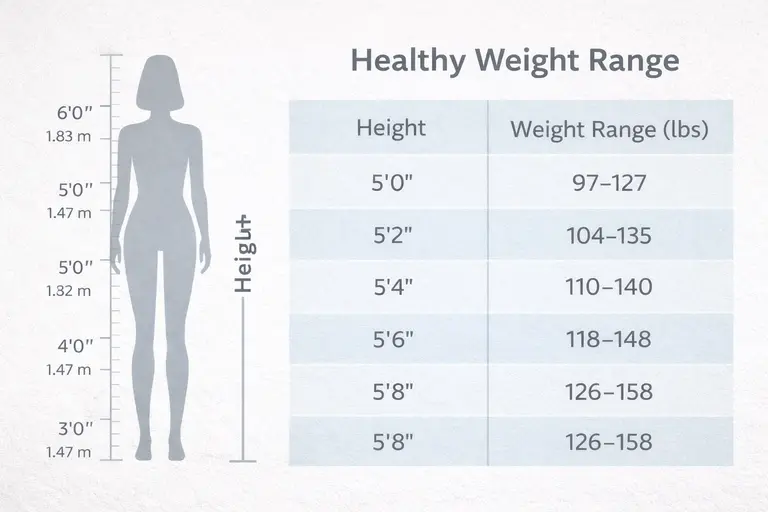
Healthy Weight Chart for Women
|
Height |
Healthy Weight (kg) |
Healthy Weight (lbs) |
|---|---|---|
|
150 cm (4'11") |
41–56 kg |
90–123 lbs |
|
152 cm (5'0") |
43–58 kg |
94–128 lbs |
|
155 cm (5'1") |
44–60 kg |
97–132 lbs |
|
157 cm (5'2") |
46–62 kg |
101–136 lbs |
|
160 cm (5'3") |
47–64 kg |
104–141 lbs |
|
163 cm (5'4") |
49–66 kg |
108–145 lbs |
|
165 cm (5'5") |
51–68 kg |
111–150 lbs |
|
168 cm (5'6") |
52–71 kg |
115–155 lbs |
|
170 cm (5'7") |
54–73 kg |
119–160 lbs |
|
173 cm (5'8") |
56–75 kg |
123–165 lbs |
|
175 cm (5'9") |
58–77 kg |
128–170 lbs |
|
178 cm (5'10") |
59–80 kg |
132–176 lbs |
|
180 cm (5'11") |
61–82 kg |
136–181 lbs |
|
183 cm (6'0") |
63–84 kg |
140–186 lbs |
If you lift weights, your healthy range may sit higher. Bone structure matters too.
Use this as a guide, not a rule.
What Your BMI Says About Health Risks (Women)
BMI does not predict your future. But it can show risk patterns. Risk depends on lifestyle, genetics, and fat distribution. BMI is one piece of the puzzle.
Underweight BMI Risks
A BMI below 18.5 may signal underweight. Some women naturally stay thin and feel fine. Others may face health issues.
Possible risks include:
Low weight can weaken bones over time. This risk rises after menopause.
Overweight BMI Risks
A BMI between 25 and 29.9 falls into overweight. Many women in this range still have normal labs. But risk can rise over time.
Possible risks include:
Obesity BMI Risks
A BMI of 30 or above increases health risks more clearly.
Possible risks include:
Still, BMI does not define health. Some women with a high BMI have strong fitness and normal blood work. Others with a normal BMI may struggle with metabolic problems. Always look deeper than one number.
Why Women Gain Weight Differently (Female Metabolism Explained)
Women gain weight differently because hormones shape fat storage. Stress and life stages also change metabolism. This isn’t weakness. It’s biology.
Hormones: Estrogen and Progesterone
Estrogen supports fat storage around hips and thighs. That pattern often protects heart health. Progesterone can increase appetite before a period. It also causes water retention. That’s why many women feel “puffy” during PMS. A sudden weight jump before your period often comes from water, not fat.
Stress and Cortisol
Stress raises cortisol. High cortisol increases cravings, especially for sugar and salty foods. Chronic stress also links with belly fat storage. Many women carry stress silently, then wonder why their jeans tighten. Stress also wrecks sleep. That creates a cycle that feels impossible.
Menopause and Metabolic Shift
Menopause changes everything. Estrogen drops. Muscle mass decreases more easily. Fat storage shifts toward the abdomen. Many women feel betrayed by their own bodies during this stage. Their routine stops working. But the body isn’t broken. It’s adapting.
Sleep and Cravings
Poor sleep changes hunger hormones. It increases cravings and lowers self-control. One week of bad sleep can trigger overeating. I’ve seen it happen in real life again and again. Fixing sleep often improves weight faster than people expect.
Real Talk
Women blame themselves too quickly. Sometimes weight gain isn’t laziness. It’s burnout. It’s stress. It’s hormonal chaos. It’s a body asking for rest. BMI can give you a number. But your lifestyle explains the story behind it.
How to Reach a Healthy BMI for Women
BMI Calculator for Women: A healthy BMI comes from consistent habits. Not extreme diets. Most women fail because they try to change everything at once. Real progress feels boring. That’s the truth.
Nutrition Tips
Protein should come first. It supports muscle and helps control hunger. Fiber comes next. Fiber supports digestion and keeps blood sugar stable.
Good fiber sources include:
Avoid extreme diets. They often cause binge cycles and rebound weight gain. Drink enough water. Many women confuse thirst with hunger.
Physical Activity Tips
Walking works. It’s underrated. It burns calories without destroying your joints. Strength training matters even more for women after 30. Muscle protects metabolism and supports bone health. You don’t need a gym. Dumbbells, bands, and bodyweight exercises can do the job.
Weight Management Tips That Actually Work
Consistency beats perfection. Weight loss requires a calorie deficit. That means you burn more than you eat. But starvation is not a strategy. Mindful eating helps more than people think. Eat slowly. Stop when satisfied. Don’t eat distracted. Sleep and stress management matter. They affect hunger hormones and cravings. If you ignore those, BMI improvement becomes harder.
Calorie Needs BMI Calculator for Women (BMI + BMR Connection)
BMI shows your weight status. It does not tell you how many calories you should eat. That’s where BMR and TDEE help. BMR estimates how many calories your body burns at rest. TDEE estimates how many calories you burn daily.
What Is Basal Metabolic Rate (BMR)?
BMR is the energy your body needs to keep you alive. Your heart, lungs, brain, and organs burn calories nonstop. Muscle increases BMR. Aging often lowers it. Hormones affect it too. Crash dieting can lower BMR by reducing muscle. That makes future weight loss harder. I’ve seen women cut calories too low, lose weight fast, then regain even faster. The body fights back.
How Many Calories Should Women Eat Per Day?
Your calorie needs depend on age, height, weight, and activity.
Most adult women need:
Many women aiming for weight loss often use:
These are general estimates. Your needs may differ. Do not drop calories too low without medical guidance.
BMI Calculator for Women FAQs
Medical Disclaimer + Trust Note
BMI Calculator for Women provides general health information only. It does not replace medical advice. BMI is a screening tool, not a diagnosis. BMI cannot measure body fat percentage, muscle mass, or fat distribution. A healthcare provider can give a full assessment using medical history, lab testing, and physical measurements. This calculator follows standard adult BMI categories used by the World Health Organization (WHO) and the Centers for Disease Control and Prevention (CDC). If you are pregnant, under 18, breastfeeding, or managing a medical condition, speak with a qualified healthcare provider before making health decisions.
Editorial Policy Statement
We publish health content for educational purposes. We base information on trusted medical sources and public health organizations. We aim for accuracy, clarity, and real-world usefulness.