
How to Calculate BMI (Body Mass Index) – Complete Guide
Quick BMI Calculator
Enter your height and weight to calculate BMI instantly.
Introduction
How to Calculate BMI : Body Mass Index, or BMI, compares your weight to your height to estimate weight status. Doctors and public health experts use it as a simple screening tool. The World Health Organization (WHO) and the Centers for Disease Control and Prevention (CDC) support its use for adults. BMI does not measure body fat directly. It gives a fast signal about possible health risk. Many people search for BMI because they want clarity. They want to know if their weight falls within a healthy range. Some worry about obesity. Others worry about being underweight. Many start a fitness journey and need a baseline.
BMI provides that starting point. It requires no special equipment. It takes less than a minute to calculate. Adults often check BMI during routine exams. Schools use it in health screenings. Parents review BMI-for-age charts for children through CDC growth references. When I first calculated BMI by hand, I expected complex math. The formula surprised me. You divide weight by height squared. That is all. In metric units, BMI equals weight in kilograms divided by height in meters squared. In imperial units, divide pounds by inches squared and multiply by 703.
This small equation carries real meaning. A single number places you into a weight category. WHO defines those categories clearly. They include underweight, normal weight, overweight, and obesity. Doctors use these ranges worldwide. BMI does not tell the full story. Muscle mass, age, and fat distribution matter. Still, BMI remains one of the most trusted screening tools in modern healthcare. Its power comes from simplicity. You need only height and weight. No lab test. No scan. Just honest measurement and basic math.
What Is BMI?
BMI stands for Body Mass Index. It expresses your weight-to-height ratio as one number. Experts classify it as an anthropometric measurement because it uses body measurements. Doctors also call it a health measurement index. WHO defines BMI as weight in kilograms divided by height in meters squared. The CDC uses the same formula. This shared standard ensures global consistency. Researchers can compare health data across countries because the formula never changes.

BMI helps estimate whether your weight falls within a healthy range. It does not diagnose disease. It does not measure fat directly. It works as a screening tool only. Screening tools flag possible risk. They do not confirm illness. Doctors calculate BMI during routine visits. A rising BMI over time may signal increased risk. The CDC links higher BMI levels with heart disease, stroke, and type 2 diabetes. These associations appear consistently in large population studies.
Public health agencies rely on BMI to track obesity trends. WHO monitors global BMI data to guide prevention strategies. Governments design nutrition and activity programs based on this information. BMI gives structure to public health planning. For children and teens, doctors calculate BMI the same way. Then they compare the result to CDC growth charts. These charts show percentiles by age and sex. A percentile explains how a child compares to peers. This method accounts for growth and development. I view BMI as a checkpoint, not a verdict. It offers direction without complexity. Its strength lies in clarity. It translates two simple numbers into useful insight.
BMI Formula Explained
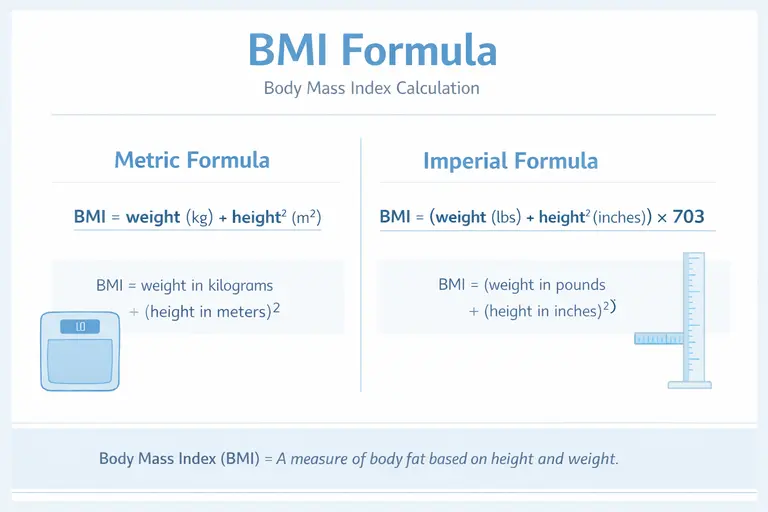
Metric Formula (kg/m²)
WHO defines the standard formula:
BMI = weight (kg) ÷ height² (m²)
First, measure weight in kilograms. Use a reliable scale. Remove shoes and heavy clothing. Second, measure height in meters. If your height appears in centimeters, divide by 100. Third, square your height. Multiply height by itself. Fourth, divide weight by the squared height.
Example:
Weight = 68 kg
Height = 1.70 m
1.70 × 1.70 = 2.89
68 ÷ 2.89 = 23.5
BMI equals 23.5. WHO classifies this as normal weight.
Imperial Formula (Pounds and Inches)
CDC provides the imperial formula:
BMI = (weight in pounds ÷ height² in inches) × 703
The number 703 adjusts for unit differences. It ensures the final result matches the metric formula.
Example:
Weight = 150 pounds
Height = 65 inches
65 × 65 = 4,225
150 ÷ 4,225 = 0.0355
0.0355 × 703 = 24.9
BMI equals 24.9. This sits at the upper end of normal weight.
Using Kilograms and Centimeters
If height appears in centimeters, divide by 100 first.
Example: 165 cm becomes 1.65 m.
Then apply the metric formula. This practical method works at home with simple tools. Accuracy matters. Small measurement errors affect the final number.
BMI Chart and Categories
After calculation, interpretation matters. WHO defines adult BMI categories as follows:
BMI less than 18.5: Underweight
BMI 18.5–24.9: Normal weight
BMI 25–29.9: Overweight
BMI 30 and above: Obesity
The healthy BMI range falls between 18.5 and 24.9 for most adults. Research from WHO and CDC links this range with lower risk of chronic disease. Underweight may signal nutritional deficiency or underlying illness. Doctors often investigate unintentional weight loss. Overweight suggests increased risk for high blood pressure and metabolic changes. Obesity shows stronger links to cardiovascular disease, type 2 diabetes, and certain cancers. WHO further divides obesity into classes based on severity. Higher classes link with greater health risk. I see the BMI chart as a map. It shows your current position. It does not define your future.
What BMI Does Not Tell You
BMI cannot measure body fat directly. It cannot separate muscle from fat. A muscular athlete may show a high BMI without excess fat. BMI also ignores fat distribution. Abdominal fat carries higher cardiovascular risk. Waist circumference and waist-to-hip ratio provide additional insight. Body fat percentage reveals how much of your body consists of fat tissue. Lean body mass reflects muscle and organs. BMI cannot distinguish these components. Basal Metabolic Rate estimates calorie use at rest. Muscle mass influences BMR. BMI does not measure metabolic health. In clinical practice, BMI starts the conversation. It does not end it. Doctors often combine it with blood tests, blood pressure readings, and lifestyle evaluation.
Health Risks Linked to BMI
Underweight individuals may face weakened immunity and bone loss. Overweight increases strain on joints and raises blood pressure risk. Obesity shows strong association with cardiovascular disease and type 2 diabetes. Excess body fat promotes inflammation and insulin resistance. CDC data consistently shows higher BMI levels link with greater chronic disease risk. These risks develop gradually. Early awareness allows preventive action. BMI offers an early warning signal. It supports prevention, not panic.
Ideal Body Weight vs BMI
BMI measures risk. Ideal body weight estimates a target range. They serve different purposes. Formulas like the Devine method estimate weight based on height and sex. These formulas provide guidance, not guarantees. Two people may share the same BMI but differ in body composition. One may carry more muscle. The other may carry more fat. Body composition analysis reveals this difference. I treat BMI as a screening step. I treat ideal body weight as a planning guide. Health depends on habits, strength, and metabolic balance, not one number.
Example of BMI Calculation
Metric example:
Weight = 72 kg
Height = 1.68 m
1.68 × 1.68 = 2.82
72 ÷ 2.82 = 25.5
BMI equals 25.5. This falls into the overweight category. It signals increased risk, not disease.
Imperial example:
Weight = 185 pounds
Height = 70 inches
70 × 70 = 4,900
185 ÷ 4,900 = 0.0378
0.0378 × 703 = 26.6
BMI equals 26.6. This also falls into the overweight range. Interpretation remains the same worldwide. Adults between 18.5 and 24.9 fall within normal weight.
FAQ About ( How to Calculate BMI )
Expert Insight and Context
Adolphe Quetelet developed the original formula in the 1830s. He designed it to study population averages, not diagnose individuals. Researchers later renamed it Body Mass Index. BMI remains widely used because it works at scale. It requires no lab tests. It costs nothing to calculate. WHO and CDC continue to endorse it for population health monitoring. “BMI is not perfect, but it remains one of the most accessible public health screening tools worldwide.” This balanced view reflects modern medical consensus.
Final Summary About ( How to Calculate BMI )
How to Calculate BMI : BMI compares weight to height using a simple formula. In metric units, divide kilograms by meters squared. In imperial units, divide pounds by inches squared and multiply by 703. A BMI between 18.5 and 24.9 falls within the normal range for most adults. Higher or lower numbers signal possible health risk. BMI serves as a guide, not a diagnosis. It opens the door to deeper evaluation. If your BMI concerns you, consult a qualified healthcare professional. Combine BMI awareness with balanced nutrition, regular movement, and consistent sleep. Use the number wisely. Let it inform your decisions, not define your worth.